Is your Orient
the real deal?
Orient is one of Japan's most respected watch brands, known for exceptional value and in-house movements. Their popularity — especially models like the Bambino and Kamasu — makes them a target, but the threat is unusual: outright superclones are rare. Far more common are relabelled homages, franken-watches built from mismatched parts, and grey-market imports. Here is how to tell a genuine Orient from all three.
Updated 16 July 2026 · ~9 min read
The 20-second answer
The single most reliable Orient authentication check is the movement. Genuine Orients run in-house automatic calibers — principally the F6922 (day-date) and F6724/F6722 (date-only) — with a rotor signed ORIENT and the caliber number, beating at 21,600 vph with hacking and hand-winding. A blank rotor, a Miyota 8215 or a DG2813 clone means fake. Then confirm the dial's double-lion emblem, the caseback model code, and that dial, movement and bracelet all belong to the same reference — because Orient is relabelled and frankened far more often than it is cloned.
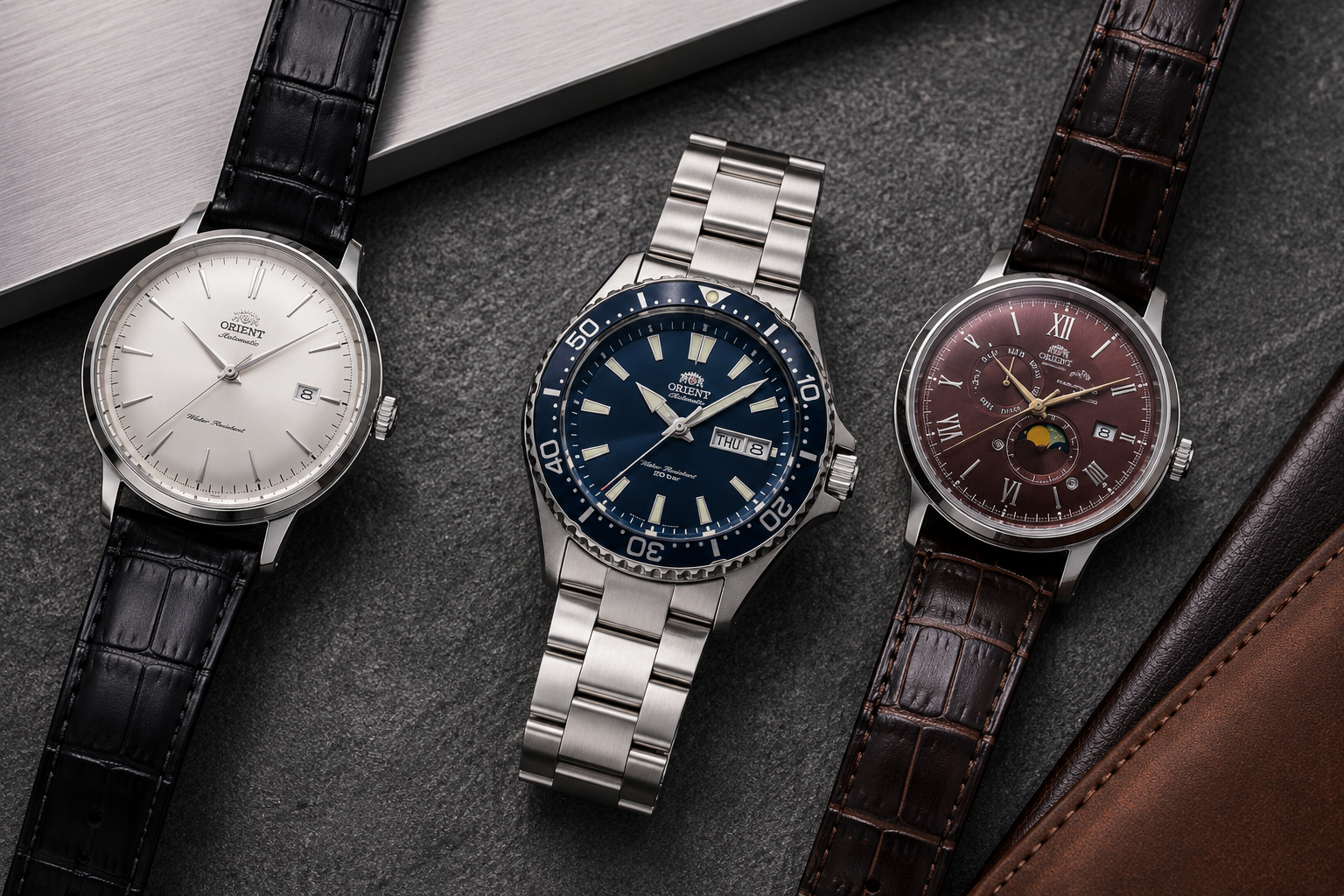
How to authenticate an Orient watch
Work through six checks in order of reliability. The movement and caseback engravings are the hardest for a counterfeiter or parts-swapper to fake convincingly; the crystal, crown and dial finishing catch cheaper copies. No single check is decisive on its own — a genuine Orient passes all of them and stays internally consistent.
In-House Caliber Movement Finishing
Orient is one of the few affordable brands with in-house movements. Through the display case back, check for proper finishing on the Orient caliber (e.g., F6722, F6724, 46943). The rotor should be branded with the Orient logo and movement designation. Counterfeits use generic Chinese movements with no branding.
Orient Logo Consistency
The Orient logo — a stylized shield with two lions — must be perfectly rendered on the dial, crown, case back, and buckle. The proportions, line weights, and details should be identical across all locations. Counterfeits often use slightly distorted or simplified versions of the logo.
Case Back Markings (JAPAN MADE)
Genuine Orient watches feature "JAPAN MADE" (or "JAPAN MOV'T" on some export models) engraved on the case back along with the model number, serial number, and water resistance rating. The engravings should be clean, precisely cut, and evenly spaced. Fakes often have blurry or inconsistent case back text.
Crystal Quality
Orient uses mineral crystal (on entry-level models) or sapphire crystal (on higher-end models like the Kamasu and Star). The crystal should be clear, free of distortion, and properly seated in the case. Many models feature a domed crystal that should have a smooth, even curve. Counterfeits may use cheap plastic or poorly shaped glass.
Crown Operation
Orient crowns should operate smoothly with distinct positions for winding, date setting, and time setting. The crown should pull out to each position with a positive click and push back in firmly. On models with a screw-down crown (divers), it should thread smoothly. Fakes often have loose, sloppy crown action.
Dial Printing Precision
Orient dials feature precise printing with clean text, evenly applied indices, and consistent lume application. The "ORIENT" text and model name should be crisp with no bleeding or smudging. Applied indices (on models that have them) should be firmly attached and perfectly aligned. Counterfeits often have sloppy dial work.
Read the movement: Orient's in-house F6 calibers
The most decisive Orient check is the movement, because Orient is one of very few brands under $500 that builds its own automatic calibers. Genuine modern Orients run the F6-series: the F6922 (day-date) powers the Mako II, Ray II and Kamasu; the F6724 and F6722 (date-only) power the Bambino. All beat at 21,600 vph (3 Hz) with 22 jewels, hacking seconds, hand-winding and roughly 40 hours of power reserve. The F6922 replaced the legendary 46943 caliber — which had run for over 40 years — in April 2016. Through a display caseback the rotor is signed ORIENT with the caliber number. A blank rotor, or a Miyota 8215 / DG2813 clone, is a fake or a swapped franken movement.
| Caliber | Functions | Beat / reserve | Found in |
|---|---|---|---|
| F6922 | Day-date, hacking, hand-wind | 21,600 vph · ~40h | Mako II, Ray II, Kamasu |
| F6724 / F6722 | Date, hacking, hand-wind | 21,600 vph · ~40h | Bambino, dress models |
| F6N43 / F6N47 | Power-reserve indicator, open heart | 21,600 vph · ~50h | Orient Star (F6 tier) |
| F8N64 | Power reserve, silicon escape wheel | 21,600 vph · 60h | Orient Star (premium) |
Spec sources: caliber datasheets vary slightly by revision; 46943 was the F6922's long-running predecessor.
Open-heart apertures and power-reserve indicators
Two signature Orient complications are worth learning because they are genuinely hard to fake mechanically: the open-heart aperture — a cut-out on the dial that exposes the oscillating balance wheel — and the power-reserve indicator, a fan-shaped gauge showing remaining wind. On a genuine watch the exposed balance oscillates back and forth in a smooth arc, and the power-reserve hand climbs as you wind and falls as the mainspring unwinds. On many fakes the “open heart” is a printed decoration with a fake wheel that does not move, and the reserve gauge is dead. These features appear across the Orient Star line and select standard models.
Caseback engravings, model & serial location
Turn the watch over. A genuine Orient caseback is cleanly engraved with a country-of-origin mark (JAPAN, or MOV'T JAPAN on some export pieces), the model reference, a serial number, water-resistance rating, and the case material. Modern references use an RA- prefix (for example the Kamasu is RA-AA0002L); many legacy divers use an FA-style code (such as FAA02004D for the Mako II). Cross-check that this caseback reference matches the dial and movement — a mismatch is the classic sign of a relabel or franken. You can verify a reference against Orient's own catalogue and the Orient/Epson service network.
Bracelet end-links and clasp fit
Bracelet quality is a fast tell, especially on the divers. On a genuine Orient the solid end-links seat flush against the case with no visible gap, the taper is even, and the clasp is stamped with the Orient logo and closes with a firm, precise click. Fakes and cheap franken bracelets show hollow, rattly end-links with gaps at the case, sharp unfinished edges, and an unbranded or misprinted clasp. A genuine bracelet also uses proper screw or pin-and-collar links, not friction pins that fall out.
Orient vs Orient Star: know the tier
Orient sells under two names, and confusing them is how buyers overpay for relabels. The core Orient line (Bambino, Mako, Ray, Kamasu) sits at roughly $100–$500 with F6922-class calibers rated +25/-15 sec/day. Orient Star is the premium tier at roughly $400–$1,200: more highly finished F6, F7 and F8 calibers, tighter accuracy (the F8N64 is rated -5/+15 with a 60-hour reserve and a silicon escape wheel), and signature open-heart and power-reserve dials. A watch marked “Orient Star” but fitted with a plain F6922 — or priced like a Star but built like a base Mako — is a red flag.
Relabels, frankens & grey imports
With Orient, the bigger risk is rarely a full superclone — it is a watch that is partly genuine. A relabel puts an Orient (or Orient Star) dial on the wrong case or movement. A franken mixes genuine and aftermarket parts — a real dial, a swapped bezel, a clone movement. A grey import is genuine but sold outside Orient's distribution, sometimes with a voided warranty or a swapped bracelet. All three pass a quick glance, so the defence is consistency: dial, movement, caseback reference and bracelet must all belong to the same, real, catalogued watch.
Common counterfeit signs
Generic Chinese Movement
The most reliable way to spot a fake Orient is through the movement. Genuine Orient watches use proprietary in-house calibers with the Orient logo on the rotor. Counterfeits use cheap Chinese automatic movements (like the Miyota 8215 clone or DG2813) that lack branding and proper finishing.
Incorrect Logo Details
Counterfeit Orient watches frequently have a simplified or incorrect version of the Orient shield logo. The two lions may be missing details, the shield shape may be wrong, or the overall proportions may be off. Compare the logo on the dial, crown, and case back to official reference images.
Missing "JAPAN MADE" Marking
Many fake Orient watches omit the "JAPAN MADE" case back marking or replace it with vague text. Check that the case back has the correct model number format, serial number, and country of origin marking. The engraving quality should be clean and professional, not rough or shallow.
Poor Dial Finishing & Lume
Fake Orient watches often have visibly poor dial finishing. Text may be slightly blurry, indices may be crooked or unevenly spaced, and lume application may be lumpy or inconsistent. On genuine Orient watches, even at their affordable price point, dial work is clean and precise.
Scan your Orient now
Upload a few photos and get an AI-powered authenticity report in seconds.
Start ScanningFor high-value purchases, we recommend pairing your AI scan with an in-person inspection by a certified watchmaker for complete peace of mind.
Frequently asked questions
Who owns Orient watches?
Orient Watch Co. is owned by Seiko Epson Corporation, a subsidiary of the Seiko Group. Despite this ownership, Orient maintains its own identity, designs, and in-house movements. Founded in 1950 in Tokyo, Orient has been part of Seiko Epson since 2009 but continues to produce its own calibers independently, distinguishing it from many competitors at its price point.
Does Orient make their own movements?
Yes, Orient is one of the few watch brands at their price point that produces in-house automatic movements. Their calibers, including the F6722, F6724, and 46943, are manufactured in their own factories in Japan. This is a key selling point and a crucial authentication marker, as counterfeit Orient watches typically use generic Chinese movements instead.
Are Orient watches good value for money?
Orient watches are widely regarded as offering exceptional value in the $100–$500 price range. They feature in-house automatic movements, solid build quality, sapphire crystals (on many models), and Japanese manufacturing. Models like the Bambino, Kamasu, Ray II, and Mako II are considered benchmarks for affordable mechanical watches and popular entry points into watch collecting.
How do I identify an Orient caliber through the caseback?
Most modern Orient automatics run the F6-series in-house calibers: the F6922 (day-date, used in the Mako II/III, Ray II and Kamasu) and the F6724/F6722 (date-only, used in the Bambino). All beat at 21,600 vph with 22 jewels, hacking, hand-winding and roughly 40 hours of power reserve. The F6922 replaced the long-running 46943 caliber in 2016. Through a display caseback the rotor should be signed ORIENT with the caliber number — a blank rotor, a Miyota 8215 or a DG2813 clone signals a fake or a swapped franken movement.
What is the difference between Orient and Orient Star?
Orient Star is Orient's premium tier. It uses more highly finished F6, F7 and F8-series calibers with tighter accuracy (the F8N64 is rated -5/+15 sec/day with a 60-hour power reserve and a silicon escape wheel), signature complications like the open-heart aperture and a power-reserve indicator, and better case and dial finishing. Standard Orient calibers such as the F6922 are rated a looser +25/-15 sec/day. Orient Star typically sells for $400–$1,200 versus roughly $100–$500 for the core Orient line.
How do I spot a relabelled or franken Orient?
Because Orient is more often relabelled or assembled from mismatched parts than superclone-faked, cross-check that the dial text, movement caliber, caseback model number and bracelet all belong to the same reference. Red flags include a dial signed ORIENT over a generic movement, a caseback model code that does not match the dial, replacement hands or bezels in the wrong finish, and a serial number the seller cannot photograph. A genuine Orient is internally consistent across dial, movement, case and bracelet.
Does Orient use sapphire crystal?
It depends on the model. Entry pieces like the original Mako and Ray use mineral crystal, while the Kamasu (Mako III) upgraded to sapphire, and most of the Orient Star range uses sapphire. If a listing claims sapphire on a model that shipped with mineral glass — or vice versa — treat it as a sign of a relabel or a franken. Verify the specification against the caseback reference and Orient's catalogue rather than the seller's description.
Model-specific guides
Keep reading
How to spot a fake luxury watch
The universal checklist that applies to any brand.
Watch movement authentication
Reading a caliber through the caseback, step by step.
Frankenwatch, explained
How mismatched parts create a “partly genuine” fake.
Seiko vs Orient
Two Japanese in-house makers compared.
Anatomy of a fake Rolex
A visual teardown of counterfeit tells.
Sapphire vs mineral crystal
Which Orient models use which — and how to tell.